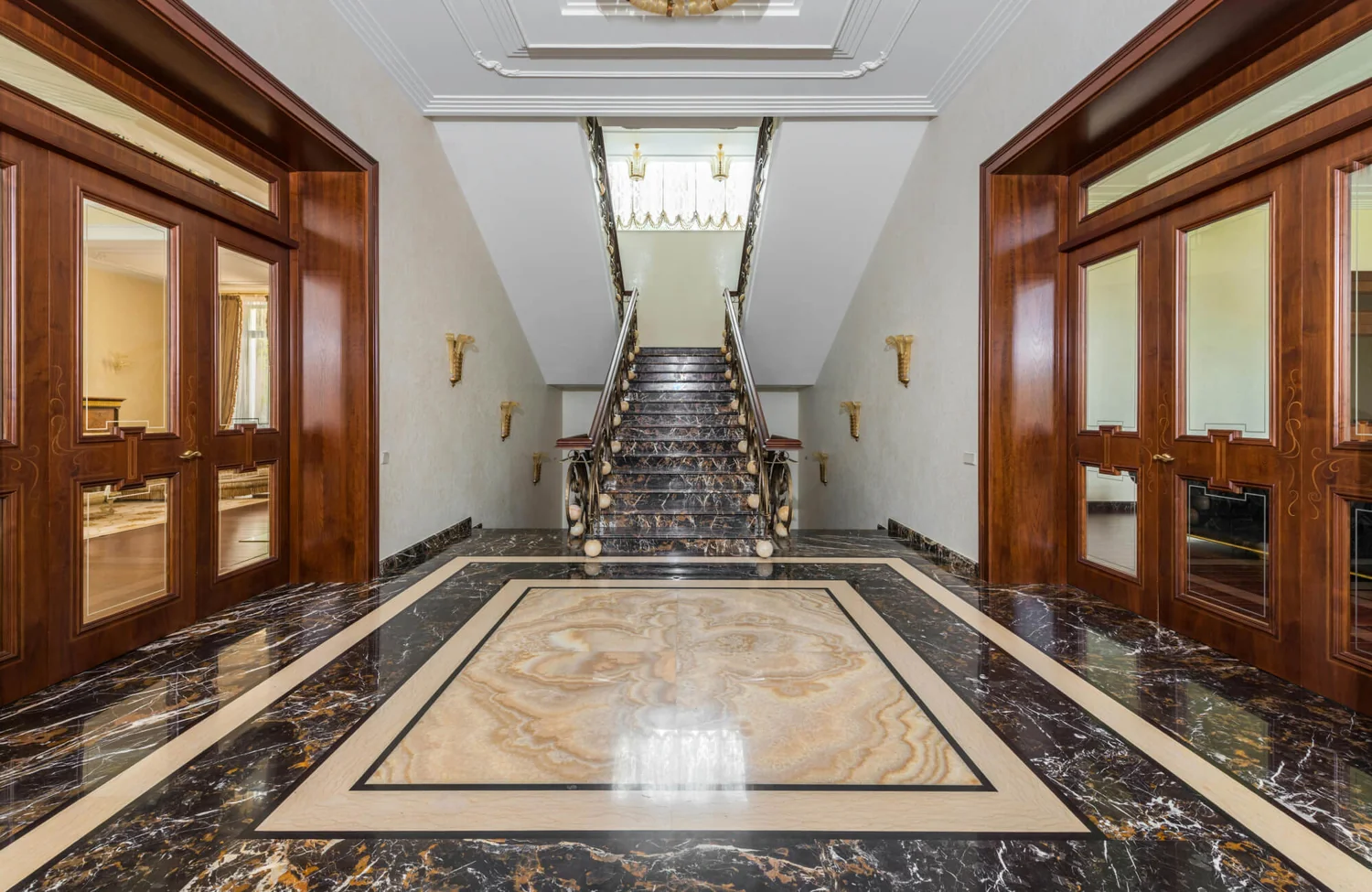
Marble floors can look impressive for years, then seem flat, cloudy, or patchy even after a thorough cleaning. Why does a clean floor still look worn? And why do entrances and walkways lose their gloss first?
One clue is hardness: the U.S. Geological Survey lists calcite at 3 on the Mohs hardness scale, while quartz is 7, which helps explain why hard grit tracked across polished marble can contribute to surface wear.
The good news is that professional marble floor restoration can correct much of this surface damage instead of simply covering it, recovering clarity while helping protect the floor for continued use.
Why a clean marble floor can still look dull
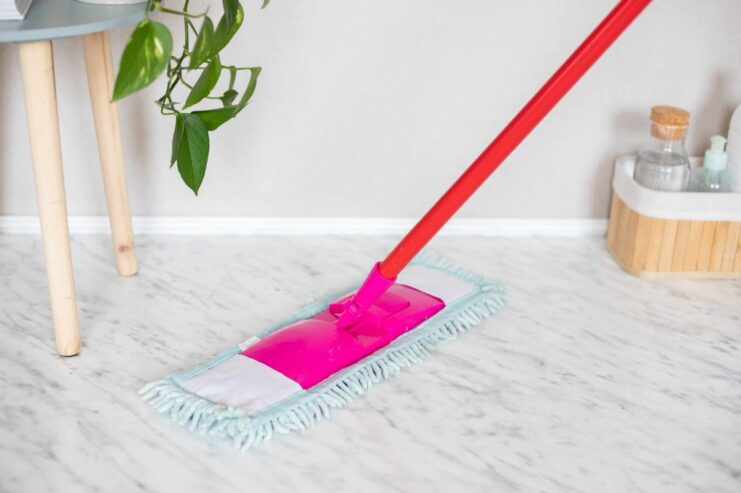
Here’s the thing: shine comes from a smooth, refined surface that reflects light evenly. When that surface becomes scratched, etched, or uneven, light scatters instead. The floor looks hazy, especially under strong overhead lighting.
Daily foot traffic is a major reason. Fine sand and hard particles carried in on shoes act like abrasives. Chair movement, rolling luggage, carts, and maintenance equipment add more micro-scratches.
Acid is another problem. The Natural Stone Institute explains that calcium-carbonate stone is sensitive to acidic solutions and warns that lemon, vinegar, and similar products can dull or etch calcareous stone.
That is why repeated cleaning sometimes changes nothing. Cleaning removes soil and residue, but it cannot mechanically repair a damaged polished layer. Once the finish itself is worn, the surface needs refinement rather than another pass with a mop.
When cleaning ends and marble restoration begins

If routine stone-safe cleaning no longer produces an even finish, the next step is usually an assessment of the stone itself. Professionals look at traffic lanes, etch marks, scratch depth, stains, grout condition, uneven tiles, and the finish the property wants to maintain.
For persistent dullness, professional marble restoration and sealing may combine diamond honing to correct surface damage, polishing to rebuild clarity, and protective treatment after the finish is restored.
Renue Hawaii uses this type of approach for hotels, resorts, restaurants, condos, and other high-traffic properties where stone has to withstand daily guest, staff, luggage, and maintenance traffic.
The distinction is simple: restoration corrects the stone surface. A quick shine product may change the appearance temporarily, but it does not necessarily remove the scratches, etching, or worn layer causing the dullness.
Etching, scratching, staining, or residue? Know the difference
Not every dull mark needs the same treatment. Before polishing begins, a professional needs to identify what actually changed.
|
Problem |
What it often looks like |
Typical response |
| Surface residue | Cloudy film or streaks | Stone-safe cleaning and rinsing |
| Etching | Dull, pale, or rough-looking spot | Honing and/or repolishing |
| Fine scratches | Haze in traffic lanes | Progressive diamond honing |
| Stain | Color change within the stone | Stain-specific treatment |
The Natural Stone Institute notes that acid can etch stone without necessarily leaving a stain, while some incidents cause both. It also recommends refinishing or repolishing for etched areas and professional attention for deeper scratches.
Diagnosis matters because aggressive polishing is unnecessary when the issue is residue, while cleaning alone will not solve an etched surface.
Matching the method to the damage prevents wasted work and reduces the risk of creating an uneven finish.
How professionals restore marble with diamond honing and polishing
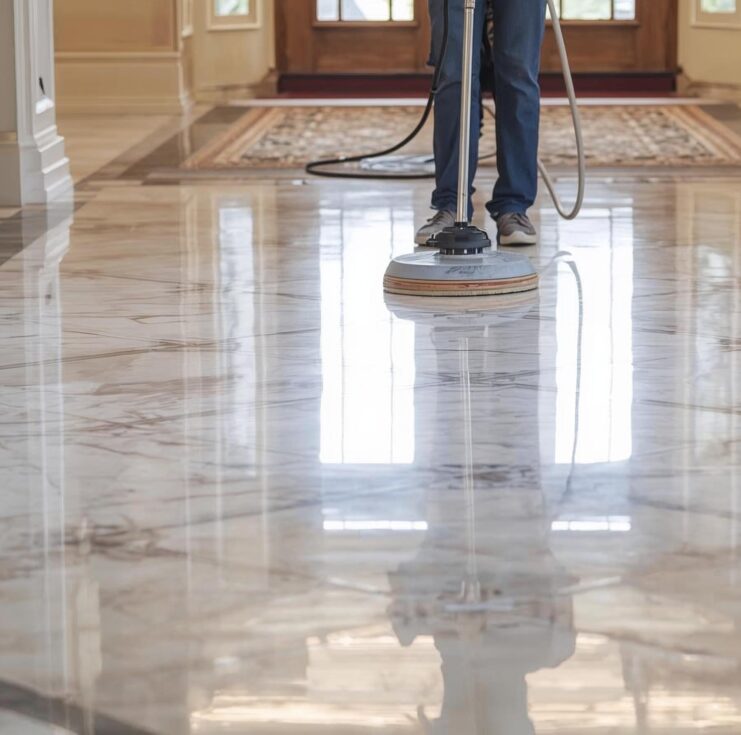
Let’s take a closer look at the mechanical part of marble floor restoration. Professionals commonly use controlled diamond abrasives, starting only as coarse as the damage requires. Progressively finer steps refine the surface until scratches from the previous stage are removed and the desired finish can be rebuilt.
A typical process may include:
- inspection, cleaning, and a test area;
- honing with selected diamond grits;
- polishing to the required sheen;
- edge and transition detailing.
A lightly dulled lobby does not need the same treatment as marble with deep scratches or severe etching.
That is where experience matters. The objective is not to remove as much stone as possible. It is to correct only the damaged surface needed for a consistent finish, then polish that refined surface so it reflects light clearly again. Professional restoration therefore recovers appearance by working on the marble itself rather than hiding wear beneath a temporary shine.
Why sealing comes after restoration, not instead of it
Sealing is useful, but it is one of the most misunderstood steps in marble care. An impregnating sealer is intended to improve resistance to liquids and staining; it does not rebuild a worn polish.
The Natural Stone Institute says sealing makes stone more stain resistant, not stain proof.
Key fact: A sealer is not automatically an anti-etch coating. Standard impregnating sealers can improve stain resistance, but calcium-based marble can still react with acids.
That is why the sequence matters. If the floor is scratched, etched, or worn, professionals first correct the surface through honing and polishing. Protection is considered after the desired finish returns.
For busy properties, proper protection can support easier routine maintenance, but it does not replace good housekeeping. Stone-safe cleaners, prompt spill response, clean entrance matting, and procedures that limit new abrasion remain essential.
Why professional restoration matters more in high-use properties
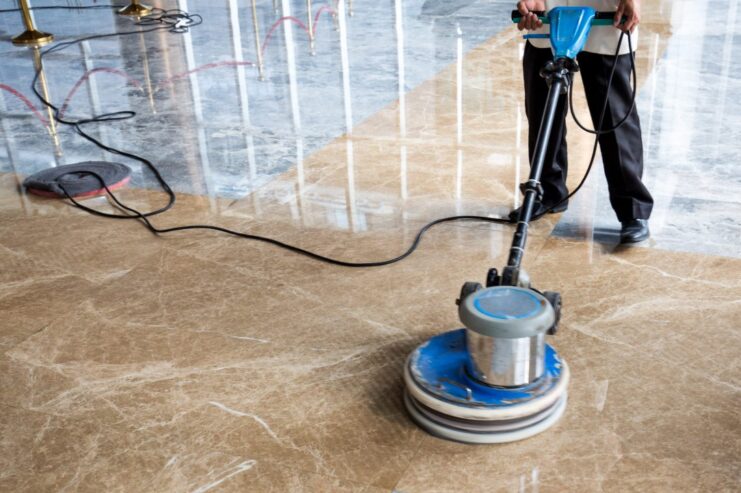
In a home, a dull patch may be irritating. In a hotel lobby, restaurant entrance, office reception area, or condominium common space, uneven marble becomes part of the property’s first impression.
High-use floors also develop concentrated traffic lanes, so the center of a corridor may look noticeably flatter than the edges.
Professional restoration can recover a more uniform finish while correcting damage that routine cleaning leaves behind. The most valuable outcomes are:
- restored shine and clearer reflection;
- reduced visibility of traffic wear and fine surface damage;
- a more consistent appearance in guest-facing areas.
For commercial properties, that makes restoration more than a cosmetic fix. Correcting wear and adding appropriate protection can help preserve the existing marble, support its long-term surface performance, and delay the disruption and expense associated with premature replacement.